In my encounters with people on this planet, I have met a surprising number who do not understand how to use the simple thermostat. Consequently many public and private buildings are overheated, causing a massive waste of energy, discomfort and unhealthy conditions.
Let's get it clear - a thermostat is a clever and simple device for maintaining a desired temperature, it does not dial up heat more or less quickly.
Let's say your thermostat has a dial numbered from 1 to 10. You feel cold, so you think 'I will get warm quickly and turn the dial right up to 10.' But then the thermostat will allow the room to overheat, when you finally notice that it is too hot, you turn the thermostat down again - perhaps to number 5 where you know it is about right. Or, worse still, you open the windows to cool the room off - and start the whole process again.
But the thermostat is your friend - just turn it to number 5 and then LEAVE IT ALONE.

Tuesday, 13 March 2012

Thursday, 8 March 2012
Evolution and inspiration
The structures and processes of life on Earth revealed through science show an amazing complexity and coherence. This revelation happens long after evolution has worked its magic filter.
Sometimes a good art critic can reveal an artist's unknown 'intention' performed in an act of pure inspiration.
Sometimes a good art critic can reveal an artist's unknown 'intention' performed in an act of pure inspiration.
Wednesday, 29 February 2012
Hockney's Point of View
In his latest exhibition 'The Bigger Picture' David Hockney further explores the relationship between the observer and the world. In one experiment, he constructed a rig of 9 video cameras arranged in a grid to capture 9 pictures simultaneously. The theory of perspective which has dominated our world view since the Renaissance is based on projecting the real (3D) world onto the (1D) viewpoint of an observer.


Hockney changes this by replacing this single viewpoint with multiple points of view.

Picasso pioneered the representation of multiple points of view in one plane when he invented Cubism. Hockney has taken this a step further in his more scientific approach. Of course, the resulting picture is fragmented into a number of frames depending on the number of cameras used and Hockney clearly enjoys this fragmentation of the picture surface which he also explores in his multiple canvasses. The camera has reinforced our prejudice that a single point of view represents reality.
The seamless projection of the 'real world' onto a plane would require a scanner rather than a camera.
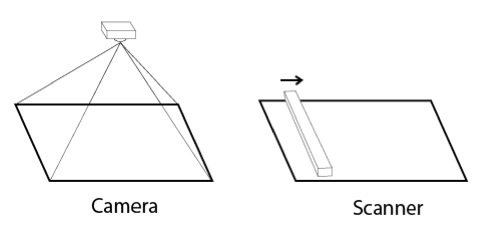
The scanner captures a more accurate reproduction of a flat document than a camera, and scanning is closer to the mechanism by which our eyes and brains construct our internal model of the world.
So Hockney shifts the perspective from the subjective single viewpoint of the observer to an objective view-plane.
Some observations ...
- How does this change our understanding of Einstein's 'observer' fundamental to relativity theory?
- We use the metaphor 'point of view' to represent a personal perspective. Could we usefully expand it to 'plane of view'?
- The 'plane-of-view' is simply a way to project the 'real' 3D world onto a 2D plane, it is a better approximation than a point-of-view projection but a truer representation would require holographic 3D and the introduction of the time dimension - in other words an exact simulation of 'reality'.
Friday, 24 February 2012

Thursday, 16 February 2012
Rewards for success. Punishment for failure.
In banking, rewards are awarded for successful risk-taking. The very nature of risk is that the outcome is open to chance. If we reward success, we are rewarding good luck, not good judgement.
Every day, careless drivers avoid accidents by a stroke of luck. Other drivers (perhaps less careless, but unlucky) cause somebody's death and face imprisonment.
Is this fair?
Every day, careless drivers avoid accidents by a stroke of luck. Other drivers (perhaps less careless, but unlucky) cause somebody's death and face imprisonment.
Is this fair?
Wednesday, 8 February 2012
What is the universe made of? (Part 2)
Perhaps we should put this question differently:
What are the components of the narrative that we call 'reality'?
1) energy/matter
2) space/time
3) a community of observers
4) language/mathematics
If any of these are missing, it won't work.
What are the components of the narrative that we call 'reality'?
1) energy/matter
2) space/time
3) a community of observers
4) language/mathematics
If any of these are missing, it won't work.
Wednesday, 23 November 2011
This, That and The Other

To me, you are The Other, you are a special part of That which I assume is like me. Of course, you see yourself as 'This' and to you, I am 'The Other'. But we both share an experience of That.
The interface between This and That is my skin. Perhaps the self does not lie inside or outside this membrane but in the membrane itself - just like the present exists in the membrane between past and future.
Subscribe to:
Posts (Atom)